

Category 'Chiropractic'

As a society we generally sit down way too much!  Whether it is due to our job, hobby, relaxing time or even sleeping, we all sit down more than we should. Unfortunately, the implications of leading a sedentary lifestyle in and out of work can lead to more serious outcomes if not addressed asap. If you are a typical 'office worker' and work 35-40 hours per week and sit at the desk all day then you will generally not get up much in your normal day, apart from lunch and toilet breaks. If done over a prolonged period of time , then this can lead to physical symptoms and sometimes more serious conditions.

Sitting

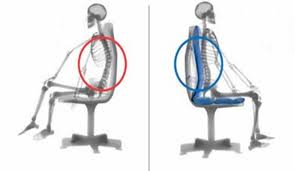
The human body is built to move and not sit still all day.  It is made up of 360 joints, over 700 muscles,  206 bones and billions of nerves.  Together all these components work as a finely tuned unit to enable us to move, run, walk and perform all of our daily activities. Image result for sit up straight at the desk Blood flow in the human body is dependent on movement, allowing it to circulate properly and reach all areas of the body that require it. Nerve cells benefit from movement so they are able to communicate with the brain and muscles far easier. When we are stationary or sitting, the muscles do not get as much blood and oxygen and the nerves do not function to their optimum level.  The result can sometimes be very obvious! sitting

Spine

The spine is held together by joints, muscles and ligaments, enabling us to stand or sit upright.  Sitting for prolonged periods of time in the same position can have an impact on the curvature of the spine and alter the way in which these structures function.  As the person sits with their shoulders rounded and their back hunched over, the joints are compressed, the chest cavity is decreased, the muscles are stretched or overworked.  This all leads to the inevitable, this being aches and pains! The reason for this is as the spine is compressed during the poorly adopted posture, the nerves, arteries and veins are also compressed,along with the legs continuously being bent, thus reducing blood flow.  The body depends on these vital structures to continue functioning automatically without any problems, therefore allowing everyday activities and exercises to be carried out successfully and pain free.  Although, if this is not the case then a symptom such as swelling can appear due to the reduction of blood flow in the given region. Eg . Sitting down in the office with legs crossed all day =  can result in swelling in the ankle or numbness in the leg, calf or foot.

Weight & further complication

Sitting for long periods of time can temporarily deactivate lipoprotein lipase.  This is an enzyme in the walls of capillaries that breaks down fats in the blood.  If the enzyme is deactivated then the fat cells will build up and potentially cause blockages in the capillaries.  This can result in a condition called Atherosclerosis.  Atherosclerosis is a disease by which the arteries thicken due to a build up of plaque.  The plaque consists of fat, cholesterol, calcium and other substances in the blood. The blockage in the artery can then lead to a lack of blood flow to the heart and other major organs.  In serious cases this can result in a heart attack, stroke or even death.

Brain

Prolonged sitting  reduces blood flow throughout the body and consequently to the brain.  The brain must receive a constant supply of oxygen rich blood to keep us alive.  The more we sit, the more restricted blood flow is, the less blood flow to the brain.  Being alert and switched on requires a constant flow of blood to the brain, but unfortunately the lack of blood flow when sitting for long periods of time can see concentration levels dip.  This can obviously have an impact on someone's job, driving or any activity that requires a certain degree of concentration. Lastly, to put everything into perspective, this is not a topic to take lightly and more of us should be aware of the implications of a sedentary lifestyle in and out of work.  Having a basic education and education others is what will help our society to be a healthier one.  Research has been published showing a link to conditions such as specific types of cancer, diabetes, liver  kidney problems. So not just the simple back pain that we all moan about each day.

Top tips from a chiropractor...

  • Get up every 30 minutes and have a walk around and a stretch.
  • Sit up straight at your desk
  • Stay well hydrated
  • Try to exercise for at least 30 minutes per day

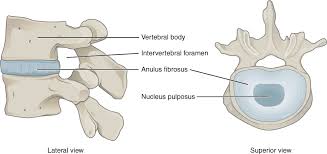
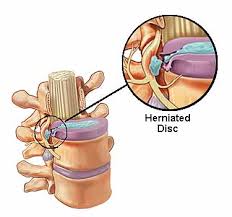
Before we talk about a condition known most commonly as a 'slipped Disc', it is important to know where and what it actually is. The discs lie between the vertebra in the spinal column, which span from the base of your skull down to the small of your back. The discs are gelatinous in nature and consist of an inner (nucleus pulposus) and outer layer (Annulus Fibrosis). They act as shock absorbers to the spine, enabling the body to carry out normal everyday activities with function and ease. IVD When a disc is herniated, prolapsed or 'slipped' then this basically means that the inner layer has been compromised. When the back is placed under extreme pressure or force, the gel-like layer can protrude outwards and tear. Depending on the severity of the tear and the cause, the gel then leaks out and can press on a nerve at that level of the spine. This dictates the area by which the person will feel the symptoms. The lowest disc being the L5/S1 is the most commonly damaged region and accounts for approximately 95% of disc herniations. The lower the disc, the more pressure is placed upon it, hence why the L5/S1 is the most commonly affected. A typical example of a patient presenting to the clinic with a slipped disc, would be: 33 year old female office worker that works 40 hours per week sat at a desk with a generally bad posture. Whilst doing a kettle bell class in the evening she bent down to pick up the kettle bell and felt her back go. Pain was a severe 8/10 and now refers from the lower back on the right, down into the gluteal muscles, hamstring and into the toes. Bending forward brings on the pain and daily activities are a struggle. disc bulge This is a typical presentation of a herniated disc. There may also be weakness in the lower limb muscles, sensation changes, numbness and sometimes people may complain of changes in their bowel and bladder movements. The main causes for a disc complaint in the lower back are age, trauma, posture, obesity and smoking, with the most common age group between 20-40. Although extreme or heavy pressure on the spine usually causes a damaged disc, it can also be caused something innocuous, such as bending down to pick a pen up. If the spine has been damaged through constant postural problems or previous trauma then the disc may simply be waiting to tear no matter what the cause. Chiropractors are well trained diagnostic musculoskeletal specialists. They focus on diagnosis, treatment and management of the most common conditions that we suffer from everyday. With regards to the disc injury, the Chiropractor would take a full history of the presenting complaint, examine the patient thoroughly and explain their findings. Following this, treatment may be provided straight away or additional advice such as ice or exercises may be given. Over the period of a given number of treatments the Chiropractor would use their expertise in spinal manipulation to ease the pain and restriction in the spine , thus reducing the inflammation around the injured region. Every Chiropractor has a slightly different approach to a patient and may use varied manual techniques when treating a condition, but there is one constant . . . . . . we are here to help, diagnose, treat, manage and advise. Be proactive and treat the spine before you treat the pain!

One of the most frequent questions I am asked by patients every week is 'So do I use heat or ice for my neck pain?' The answer is ice!!! inflammation pic

Why ice?

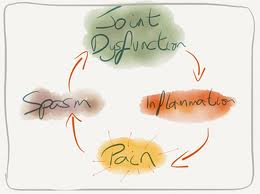
With any injury, sprain or strain where a joint or muscle has been stressed to the extreme and causes pain and dysfunction, then ice should be applied immediately. The instant effect of ice is to reduce the swelling and inflammation around the injured area. This reduces the pain and discomfort, allowing for easier range of motion in the joint and general function. An example I use in my clinic is: If you were to sprain your ankle and the joint became black and blue, swollen and extremely painful then you would rest, ice and take the pressure of it. The problem with the neck and back is that there are so many smaller joints either side of the spine that can become inflamed due to everyday activities, work, posture, sport and exercise. Sometimes these smaller joints do not appear to be as severe as maybe an ankle would present. We may not need to rest or take time off work with back and neck pain, so we simply continue as normal, thus aggravating the inflamed joints and irritated muscles. My best advice is to listen to your body when it tells you something is wrong or gives you a hint that something is brewing. Lastly, always use ICE instead of heat with inflammation type injuries or conditions as the heat can actually make things worse is some cases. To summarise, ice is for injuries — calming down damaged superficial tissues that are inflamed, hot, red and swollen. The inflammation process is healthy, normal and natural, but can also be incredibly painful and so ice can be used as an effective form of pain management. Heat is for muscles, chronic pain, and stress — taking the edge off symptoms of muscle ache and stiffness, which have many unclear causes.

Tips for icing injuries

Put an ice-pack on the injured area for 15 minutes, before returning it to the freezer for 15 minutes. Repeat this three times. If the pain persists, make sure to get it checked out by a medical professional as it could be more serious than you initially realised.

11
Mar

Why is Sitting bad for my Posture?

Chiropractic | Comments Off on Why is Sitting bad for my Posture?

As a society we generally sit down way too much!  Whether it is due to our job, hobby, relaxing time or even sleeping, we all sit down more than we should. Unfortunately, the implications of leading a sedentary lifestyle in and out of work can lead to more serious outcomes if not addressed asap. If […]

5
Feb

A ‘Slipped Disc’ and How Chiropractic Care Can Help!

Chiropractic | Comments Off on A ‘Slipped Disc’ and How Chiropractic Care Can Help!

Before we talk about a condition known most commonly as a ‘slipped Disc’, it is important to know where and what it actually is. The discs lie between the vertebra in the spinal column, which span from the base of your skull down to the small of your back. The discs are gelatinous in nature […]

21
Jan

Ice or Heat – Which one do I use?

Chiropractic | Comments Off on Ice or Heat – Which one do I use?

One of the most frequent questions I am asked by patients every week is ‘So do I use heat or ice for my neck pain?’ The answer is ice!!! Why ice? With any injury, sprain or strain where a joint or muscle has been stressed to the extreme and causes pain and dysfunction, then ice […]

Call us now!